

These Trading Rules are to serve only as a guide for transactions. It is understood that the parties to such transactions are free to adopt, modify or disregard any of these Trading Rules. The parties to transactions hereby acknowledge familiarity with the text of the Canola Oil Trading Rules of the Canadian Oilseed Processors Association.
These Trading Rules have been amended effective September 1, 2026. The Rules have been revised with updates to:
Subject to any express provisions to the contrary, contained in these Trading Rules, or in any contract into which these Trading Rules are incorporated, the said contracts and these Trading Rules and the construction, validity and performance thereof shall be governed by and construed in accordance with the laws of the Province in which the head office of the Seller is located (including such laws of Canada as may be applicable), irrespective of the domicile or residence of the Buyer.
(a) The standard of quality shall be fair average quality of the designated type of Canola Oil which must conform to the standard specifications of the Canadian Oilseed Processors Association.
(b) The standard specifications are subject to modification from time to time as conditions may warrant, upon recommendation of the COPA Oil Trading Rules Committee.
Canola Oil shall be the oil produced from the low erucic acid oil-bearing seeds of varieties derived from Brassica napus, Brassica rapa and/or Brassica juncea species. The type of Canola Oil covered by these Trading Rules shall be of the following:
(a) Type I, otherwise known as Crude Super Degummed Canola Oil
(b) Type II, otherwise known as Crude Degummed Canola Oil
(c) Type III, otherwise known as Crude Canola Oil
(d) Type IV, otherwise known as Refined, Bleached and Deodorized Canola Oil
Other Canola Oils, including specialty oils, may be traded under these Canola Oil Trading Rules.
Canola Oils of the types (a), (b) and (c) referred to in Section 2 shall conform to the following specifications:
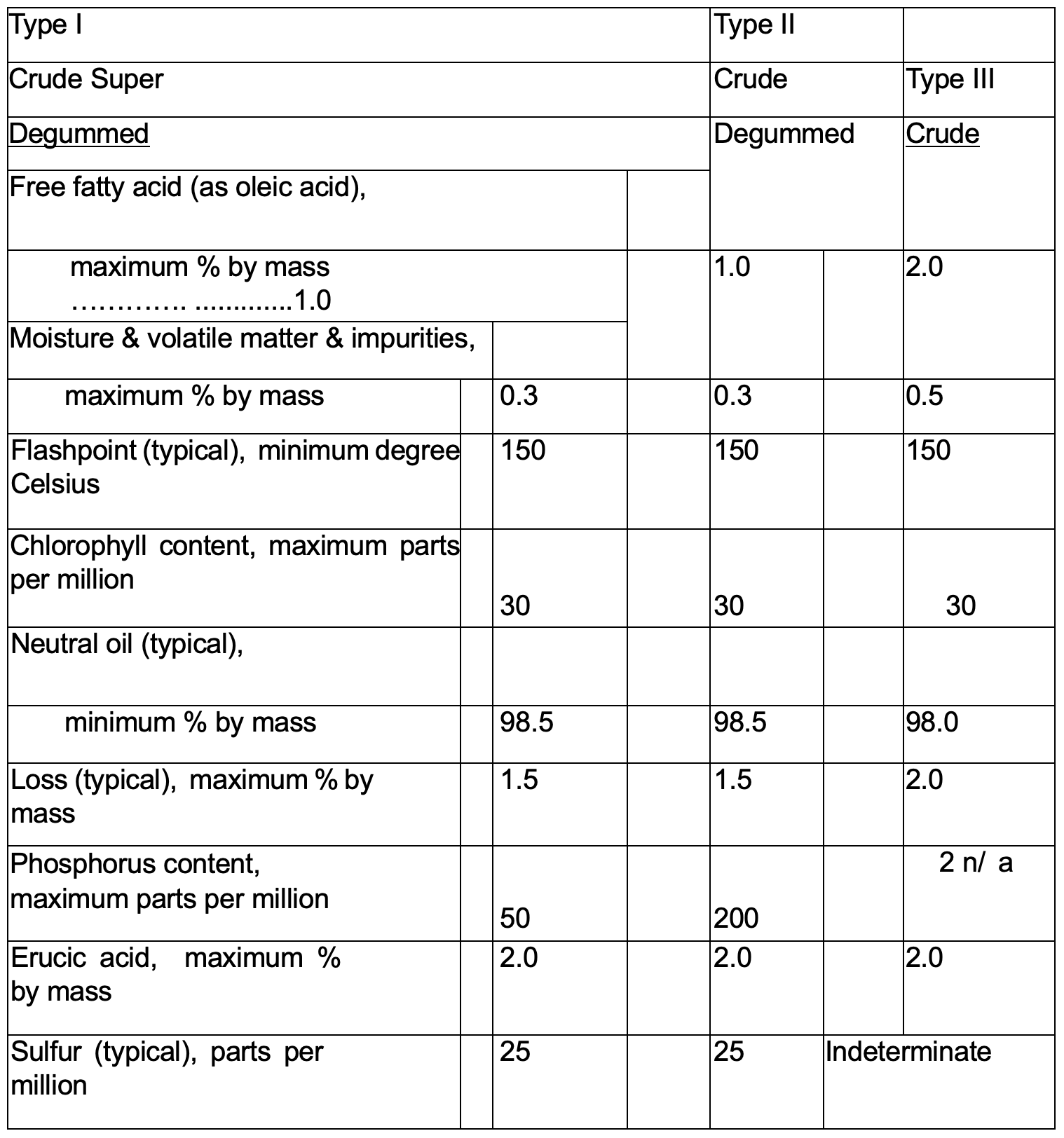
2 Not applicable.
Analytical methods shall be those of the American Oil Chemists’ Society (AOCS), except as otherwise specified.
| wdt_ID | Analysis | Referee Method |
|---|---|---|
| 2 | Free fatty acid | AOCS Ca 5a-40 |
| 4 | Moisture & volatile matter & insoluble impurities | M & V AOCS Ca 2d-25 or Ca 2b-38 or Ca 2c-25 I.I. AOCS Ca 3a-46 |
| 5 | Flashpoint | AOCS Cc 9b-55 or Cc 9c-95 |
| 7 | Chlorophyll content | AOCS Cc 13d-55 |
| 9 | Neutral oil, minimum | AOCS Ca 9f-57 |
| 11 | Loss, maximum | AOCS Ca 9a-52 or Ca 9f-57 |
| 13 | Phosphorus content | AOCS Ca 20-99 |
| 15 | Erucic acid | Association of Official Analytical Chemists 996.06; 17th Edition |
| 17 | Sulfur | AOCS Ca 17-01 |
(a) The Official Sample
The official sample shall be held by the Seller and shall be taken at the point of origin in accordance with section C 1-47 of the official standards of analysis of the American Oil Chemists’ Society. The sample shall be a minimum of one (1) litre in quantity, and shall be packed in a clean and dry container, consisting of either a tinned metal container or a high density polyethylene bottle fitted with a cap. The official sample shall be retained by the Seller for thirty (30) calendar days and shall be identified by:
(i) car number and/or appropriate vehicle identification number; and
(ii) shipping date exit plant of origin.
(b) Adjustment Procedures
Canola Oil not meeting the specifications of the type of oil contracted within the sales agreement, shall be subject to the following procedures:
(1) Free fatty acid – allowances for oils with excess fatty acid content shall be at the rate of:
(2) Moisture and impurities
(3) Chlorophyll – allowance for excess chlorophyll shall be at the rate of:
(4) Phosphorus content
(5) In some years, adverse climatic conditions may inhibit the ability of processors to control specification limits. Under these circumstances, other acceptable tolerance limits may be the subject of negotiation between the Buyer and the Seller.
If the Seller’s and the Buyer’s analyses differ and an agreement cannot be reached, the dispute shall be settled by the Official Referee Laboratories, the cost of which shall be paid by the unsuccessful party.
To qualify, the Official Referee Laboratory must be a mutually agreeable AOCS accredited laboratory of which the accreditation body is a signatory to the International Laboratory Accreditation Cooperative (ILAC) .
Scope of accreditation is the International Organization for Standardization (ISO)/ International Electrotechnical Commission (IEC) 17025 .
Qualified ILAC signatories in Canada:
Qualified ILAC signatories in the USA:
Qualified ILAC signatory in Mexico:
Quality claims relating to Rule 1 shall be filed by electronic mail with acknowledgement of receipt requested no later than five (5) business days (defined for the purpose of these rules as any day the Chicago Board of Trade is open for business other than Saturdays, Sundays and statutory holidays in Canada) from the truck or railcar unloading date. Quality claims filed after five (5) business days shall not be honoured.
Canola Oil (crude and refined) shall be sold on a net weight basis in pounds (avoirdupois pounds) and/or tonnes (1 tonne = 2,204.6226 avoirdupois pounds).
The unit of sale, by mutual agreement between the Buyer and the Seller and as specified in the contract at the time of sale, may be a jumbo tank car, super jumbo tank car, mega jumbo tank car, tank truck, drum or bulk vessel (quantities as per vessel charter party). If the sale is made in tank cars, the weight of the tank cars shall be specified with a tolerance of + 1.5%. If the sale is made in tank trucks, the approximate weight of the tank trucks shall be specified, subject to a commercially reasonable tolerance, not to exceed 1.5%, unless otherwise agreed.
If the sale is made in drums, the approximate weight shall be specified, subject to a commercially reasonable tolerance, not to exceed 1.5%, unless otherwise agreed.
Contracts shall be completed by delivering the exact number of units with the approximate number of pounds in such containers as agreed to at the time of sale or as mutually amended thereafter.
Analytical methods shall be those of the American Oil Chemists’ Society (AOCS), except as otherwise specified.
(a) The Official Sample
The official sample shall be held by the Seller and shall be taken at the point of origin in accordance with section C 1-47 of the official standards of analysis of the American Oil Chemists’ Society. The sample shall be a minimum of one (1) litre in quantity, and shall be packed in a clean and dry container, consisting of either a tinned metal container or a high density polyethylene bottle fitted with a cap. The official sample shall be retained by the Seller for thirty (30) calendar days and shall be identified by:
(i) car number and/or appropriate vehicle identification number; and
(ii) shipping date exit plant of origin.
(b) Adjustment Procedures
Canola Oil not meeting the specifications of the type of oil contracted within the sales agreement, shall be subject to the following procedures:
If the Seller’s and the Buyer’s analyses differ and an agreement cannot be reached, the dispute shall be settled by the Official Referee Laboratories, the cost of which shall be paid by the unsuccessful party.
To qualify, the Official Referee Laboratory must be a mutually agreeable AOCS accredited laboratory of which the accreditation body is a signatory to the International Laboratory Accreditation Cooperative (ILAC) .
Scope of accreditation is the International Organization for Standardization (ISO)/ International Electrotechnical Commission (IEC) 17025.
Qualified ILAC signatories in Canada:
Qualified ILAC signatories in the USA:
Qualified ILAC signatory in Mexico:
Quality claims relating to Rule 1 shall be filed by electronic mail with acknowledgement of receipt requested no later than five (5) business days (defined for the purpose of these rules as any day the Chicago Board of Trade is open for business other than Saturdays, Sundays and statutory holidays in Canada) from the truck or railcar unloading date. Quality claims filed after five (5) business days shall not be honoured.
The subject matter of all contracts shall be Canola Oil. However, the Seller may fulfill any contract using Canola Oil conforming to the agreed specifications.
Upon mutual agreement between the Seller and the Buyer, the Seller may deliver an alternate type of Canola Oil other than that specified in a particular contract at a negotiated discount or premium.
Upon mutual agreement between the Buyer and the Seller, either party may change the point specified in the contract. Once agreed, any increase or decrease in the Seller’s cost shall be for the account of the Buyer.
Unless otherwise specified at the time of sale, terms of payment on Canola Oil are to be net cash (i.e. payable immediately upon receipt of invoice), with the method of payment to be agreed upon between the Buyer and the Seller.
The Seller reserves the right to restrict the terms of payment if, in the Seller’s sole judgement, the Buyer’s financial responsibility does not warrant shipment on terms originally stated in the contract.
Failure of the Buyer to accept delivery of, or pay for any portion of a specified quantity of Canola Oil covered by any contract shall, at the Seller’s option, release the Seller from making any further deliveries. In case of default in payment of any invoice due, the whole sum owed by the Buyer shall become due and payable at once. Interest shall accrue on all overdue amounts at a rate of 1.5% per month (18% per annum), calculated daily from the due date until payment is received in full.
Unless otherwise agreed, all unpriced contracts shall be priced at the Buyer’s option within the day’s price range, while futures markets are open and tradeable. In no case shall pricing go beyond the date of shipment or the original contracted period, whichever comes first, unless there is specific prior agreement between the Buyer and the Seller. The futures month is the negotiated futures month and shall be identified on the face of each contract. If any portion of the contract is not priced or spread the day before the expiration day of the contract futures month involved, it shall be priced or spread on the market open, next trading session. If this falls on a day futures are not tradeable, the balance of the unpriced contract shall be priced or spread at the first tradeable opportunity.
The Buyer requesting pricing on the date of shipment shall accept pricing as done by the Seller, even if the car does not actually leave on the requested date of shipment due to circumstances beyond the control of the Seller, provided that the car has been loaded.
Cash sales /must be priced by exchanging futures or any other form of market pricing agreed to between the Buyer and the Seller.
It is the responsibility of the buyer and seller to mutually arrange the shipping schedule in accordance with the designated shipping period.
Unless the exact shipping date is agreed upon by the Buyer and the Seller at the time of sale, shipment sold for a given calendar month delivery shall be interpreted as follows:
(a) monthly shipment shall be spread uniformly over agreed upon contract period; Inclusive of the last day of the month.
(b) the Buyer shall advise the Seller by electronic mail with acknowledgement of receipt requested no later than the first business day following the day that an empty tank car is billed out to the Seller’s location. See Rule 9, Section 1 and Rule 13, Section 4. Failure to provide such notice may result in shipment delays or rescheduling at the Sellers’ discretion, without liability to the Seller.
(a) The term “first half” of any month shall be construed to mean the period from the first calendar day to the fifteenth calendar day inclusive, and the term “second half” shall be construed to mean the period from the sixteenth calendar day to the last calendar day inclusive.
(b) The terms “early” or “beginning”, “middle”, and “end” or “late” in reference to any month shall be construed to mean the period from the first calendar day to the tenth calendar day, from the eleventh calendar day to the twentieth calendar day, and from the twenty-first calendar day to the last calendar day all inclusive, respectively.
(c) If the last day for shipments/deliveries falls on a Saturday, Sunday or a legal holiday, the time for shipments/deliveries shall be extended until the next business day.
(d) Washouts, close-outs or defaults shall be basis mean contract quantity without tolerances. If the contract provides for a minimum and maximum quantity, the mean thereof shall apply. Washouts and closeouts will normally be settled fifteen (15) calendar days before the end of the contract period.
It shall be the duty of the Seller, not later than the close of the business day following the day of sale, to electronically mail with acknowledgement receipt requested a contract of sale to the Buyer. In addition, the Seller shall provide confirmation of the sale by electronic mail with acknowledgement receipt requested not later than the close of the business day following the day of sale. Upon receipt of said confirmation, the parties shall check carefully all details stated therein and, upon finding any differences, immediately shall notify the other party to the contract by electronic mail with acknowledgement receipt requested.
No response by the Buyer within three (3) business days after receipt shall signify acceptance of the confirmation and a waiver of any objection to its terms.
The Buyer shall furnish instructions for shipment, and tank cars in the case the Buyer’s tank cars are specified, to the Seller, in ample time to enable the Buyer to have the Buyer’s tank cars at shipping point within period or periods specified in the contract. Under no circumstances shall the Seller be either expected or required to make physical tender of any or all oil covered by any specific contract for any specific delivery, unless the Buyer has first furnished written instructions or furnished tank cars for shipment as provided herein.
Failure of the Buyer to supply written shipping instructions shall not relieve the Seller of the responsibility of performance under the contract unless the Buyer fails to supply these shipping instructions within three (3) business days after the Seller’s electronic mail with acknowledgement of receipt requested for shipping instructions.
On all contracts for either crude or refined oil covering specific quantities for shipment during a specified period, shipment must be made during the specified time. If the Buyer fails to provide shipping instructions, or if the Seller is unable to ship within the period specified, an additional thirty (30) calendar day shipping period may be allowed, by agreement of the parties with the following penalties added to or subtracted from the contract price, depending on which party is in default:
Failure by the Buyer or the Seller on any instalment of a multi-period contract shall not be a breach of the entire contract.
After expiration of the contract period, the Buyer may not refuse to accept delivery of Oil after shipment has been made unless the Buyer has previously notified the Seller of the Buyer’s intention to cancel the contract if shipment has not been made by a particular business day subsequent to the date of the Buyer’s notification.
Failure on the part of the Seller due to uncontrollable circumstances (Force Majeure as defined in Rule 16) to deliver any instalment of Canola Oil shall not be a breach of the entire contract.
The Seller’s official weights are to govern.
If seller cannot furnish or produce official weights, then buyer has the right to have official weights taken at point of destination & those weights shall govern.
To be approved for official weighing status or to issue official weights, a Seller of Canola Oil shall have weight measures that are approved by Measurement Canada under the Weights and Measures Act.
Where a weight discrepancy arises, no allowance for shortage or damage will be made by the Seller unless the Buyer furnishes complete evidence, including a railroad inspection report, so as to enable the Seller to present a complete claim to the carrier. Weight claims shall be filed as soon as possible, but not later than five (5) business days from the car unloading date. Weight claims filed after five (5) business days shall not be honoured. The Seller’s liability shall be limited to the maximum of that which is recoverable from the carrier.
Any increases or decreases in the published rail freight charges, truck freight charges and/or any fuel surcharges that become effective after the sales contract is negotiated shall be for the account of the Buyer.
Any existing, new or increased tax, charge, duty, tariff or any similar fees or other government charges imposed by the Government of Canada or any government entity or taxing body, foreign or domestic, upon the production, sale, shipment, delivery, import or export of Canola Oil, now or after the sales contract is negotiated, shall be for the account of the Buyer. Seller shall not be required to pay, absorb, or reimburse any such charges, whether directly or indirectly, and any such charges incurred by the Seller shall be recoverable from the Buyer.
(a) Demurrage and Storage – Demurrage and/or storage charges at destination shall be the Buyer’s responsibility. Destination shall be actual or constructive destination in the event the Buyer, for any reason, is unable to take delivery of the railway car. The Buyer shall also be responsible for any demurrage and/or storage charges assessed as a result of the Buyer’s or railway’s staging of the railway car movement to destination or staging provided as a result of the Buyer’s inability, for any reason, to take delivery of the railway car at destination.
(b) Other Rail Ancillary Charges – The Buyer shall be responsible for other ancillary charges assessed by a railway company at destination or which arise as a result of the Buyer’s acts or omissions.
Routing should be determined by the seller unless specified at the time of sale or mutually agreed thereafter.
When the Buyer furnishes tank cars, the Buyer shall have the right to specify routing, provided such routing does not involve additional freight expense to the Seller over the lowest rate in the railway tariff rate to the same destination. The Seller shall not be obligated to accept any routing that results in such additional freight expense. If the Seller elects to accept such routing, any resulting excess freight charges shall be for the Buyer’s account.
When the Seller furnishes tank cars, the Seller shall have the right to specify routing with the exception of the delivering carrier which shall be at the option of the Buyer.
At the time of sale, it shall be specified whether the Buyer’s or the Seller’s tank cars are to be used. If this is not specified, the Buyer’s tank cars shall be provided and used.
All tank cars or tank trucks shall be inspected by the Seller before loading as to cleanliness and condition of the cars, and shall be sealed at the dome and the outlet valve (when so equipped), before being shipped. The Seller shall inspect the Buyer’s tank cars or tank trucks before loading and, if found unsatisfactory, shall notify the Buyer by electronic mail with acknowledgement receipt requested. The Seller shall have sole discretion to reject any tank car or tank truck it deems unsuitable for loading.
In the event tank trucks cannot be effectively inspected, they shall not be loaded until the Buyer has been notified by electronic mail with acknowledgement receipt requested and the Buyer specifically has authorized such loading. The Buyer shall have the option of replacing the tank cars or tank trucks.
In the case of tank cars or tank trucks which can be effectively inspected, the Buyer may request the Seller to clean the tank cars or tank trucks at the Buyer’s expense, or the Buyer shall accept responsibility for the condition of the Canola Oil. Any necessary cleaning and repairing shall be performed at the expense of the Buyer on the basis of actual cost. Failure by the Seller to observe the foregoing shall constitute negligence on Seller’s part, and shall relieve the Buyer of responsibility for any and all loss or damage resulting therefrom.
If a Seller’s loaded tank car or tank truck is delivered to the Buyer in faulty condition, the Buyer immediately shall request an inspection by the Seller. The Seller thereupon either shall make such inspection, or shall arrange with the Buyer to correct such faulty condition, in which event the Seller shall be liable only to the extent of the expense incurred in correcting the faulty condition.
All openings that could provide access to the interior of the rail tank car, whether loaded or empty, must be sealed with a numbered, durable, tamper evident seal whenever such car is outside the full control of either the Seller or the Buyer. Responsibility for ensuring the seals are applied and recording the numbers of such seals lies with the party last in control of the car.
If the Seller or the Buyer is found negligent of their duties due to the improper sealing and/or recording of seal numbers then that party will be held responsible for all costs, damages and/or consequences incurred to bring the truck(s) or tank car(s) back to a merchantable status suitable to the trade.
The Buyer and the Seller shall not divert or re-consign tank cars without mutual consent. Any expense incidental to reconsignment or diversion shall be for the account of the party responsible.
The Buyer agrees to empty the Seller’s tank cars promptly upon arrival and to return same empty as per the Seller’s instructions. Forty-eight (48) hours free time will be allowed for unloading once the cars are constructively placed. Charges thereafter will be at $75.00 Canadian per railcar per calendar day non pro rata OR at specified amount agreed upon by parities prior to shipment as penalty for delay in loading tank cars. These penalties are independent of any demurrage due to the railroad by the Buyer.
In the absence of instructions for return routing, the Buyer shall electronically mail with acknowledgement receipt requested the Seller for same, and, in case of delayed answer, demurrage and delay shall be for the Seller’s account. The Buyer cannot be held responsible for failure of carrier to set cars as ordered.
The Seller agrees to load the Buyer’s tank cars promptly upon arrival, provided cars have not been received at the Seller’s plant prior to scheduled loading dates. Forty-eight (48) hours free time will be allowed for loading after scheduled loading dates. Standard railroad demurrage rates shall be paid by the Seller to the Buyer as penalty for delay in loading tank cars. This penalty is independent of any demurrage due the railroad by the Seller. The Seller cannot be held responsible for failure of carrier to set cars as ordered.
Unless otherwise specifically agreed upon at the time of sale, the Seller shall pay the selling commission or brokerage to the agent or broker consummating the sale.
Commission will not be earned or paid when shipment is prevented by an act of any governmental body or by Force Majeure as defined in Rule 16. Commission or brokerage shall not be made until delivery has been made in full, or the contract otherwise disposed of.
In the event of any dispute or difference arising out of or in any way relating to, any contract to which the within Rules apply or the Rules themselves, including, without limitation, any dispute or difference as to the terms or conditions, breach, performance or interpretation of such contract or these Rules, then the same shall be settled by arbitration as follows.
Either party may submit the dispute to arbitration by giving written notice of its request to arbitrate to the other party.
Within thirty (30) calendar days after the notice is given, each shall appoint a single representative to serve as a member of an Arbitration Committee to consist of three members. The two representatives so appointed, within forty (40) calendar days from the date of notice, jointly shall select a third member, who shall be a duly qualified barrister and solicitor, to act as Chair of the Arbitration Committee.
In the event the Arbitration Committee is not constituted as aforesaid, the following provisions shall apply:
(a) In the event the Buyer fails, neglects, refuses or is unable to appoint a representative within the aforesaid thirty (30) day period, then the Seller may apply to the Court of King’s Bench (or equivalent court of superior jurisdiction) in the Province in which the Seller’s head office is located to make the required appointment;
(b) In the event the Seller fails, neglects, refuses or is unable to appoint a representative within the aforesaid thirty (30) day period, then the representative of the Seller shall be deemed to be, and the Seller shall conclusively be deemed to have appointed, such individual person as may from time to time be designated by the Canadian Oilseed Processors Association as their “designated arbitration representative”; and
(c) In the event the two appointed representatives fail, neglect, refuse or are unable to select a Chair within the aforesaid forty (40) day period, then either of the Buyer or the Seller may apply to the Court of King’s Bench (or equivalent court of superior jurisdiction) in the Province in which the Seller’s head office is located to appoint such Chair.
Within sixty (60) calendar days after the appointment of the Arbitration Committee as provided in Section 2 hereof, the party who initiated the arbitration process (the “claimant”) shall provide a statement in writing to the Arbitration Committee setting out all the matters which it intends to refer to the Arbitration Committee and all information on which the claimant intends to rely in the arbitration. A copy of the written statement must be provided to the other party (the “respondent”) at the same time.
Within ten (10) calendar days after receipt of the claimant’s written statement, the respondent shall provide to the Arbitration Committee and to the claimant a written statement in response setting out any matter which it intends to refer to the Arbitration Committee and all information on which the respondent intends to rely in the arbitration.
Only those matters which are included in or covered by the respective statements shall be considered by the Arbitration Committee.
Within fifteen (15) calendar days after the receipt by the Arbitration Committee of the written statements of the parties, the Arbitration Committee may convene a hearing of the matters referred to arbitration, or, as determined by the Arbitration Committee at its sole discretion, may accept written submissions of the parties. In the event the Arbitration Committee commences a hearing of the matters referred, it shall be at such time and place and under such conditions as may be prescribed by the Arbitration Committee, and each party shall have the right to submit evidence in support of its position.
Subject to this Rule, the Arbitration Committee may conduct the arbitration in the manner it considers appropriate.
The Arbitration Committee is not bound by the formal rules of evidence, but may hear, receive and consider any evidence which it may consider relevant.
Unless otherwise authorized by this Rule, a party communicating with the Arbitration Committee regarding the arbitration must do so in the presence of the other party or, if the communication is in writing, must provide a copy to the other party at the same time.
Each of the parties shall produce before the Arbitration Committee all relevant books, documents, papers, accounts, vouchers, entries, memoranda, plans and writings in their possession, power or control which the Arbitration Committee may require.
Each of the parties shall do all acts and things as are necessary to enable the Arbitration Committee to make proper findings respecting the matters in dispute, and neither of the parties shall obstruct, delay or prevent the Arbitration Committee from proceeding with the reference or from making its award.
The Arbitration Committee may postpone a hearing at the request of a party who satisfies the Arbitration Committee that there is a good and sufficient reason to do so.
The Arbitration Committee may proceed with the hearing in the absence of any party who fails to attend the hearing and does not obtain a postponement in advance, provided that the absent party was properly notified of the time and place of the hearing.
Within sixty (60) calendar days of the receipt by the Arbitration Committee of all evidence which it may consider relevant, the Arbitration Committee shall deliver its award by notice in writing to the Buyer and the Seller which notice shall be sufficient if given or delivered to the head offices of the Buyer and the Seller, respectively.
No action or legal proceedings shall be commenced or prosecuted by either of the parties against the other party relating to any of the matters in dispute, unless the party to be made defendant to such action or proceeding shall have refused or neglected to refer such matters to arbitration pursuant to the provisions of this Rule, or unless the time limited for making the award as aforesaid shall have expired without any such award being made.
The award of the Arbitration Committee shall be binding in all respects upon the parties, subject to the right of either party to appeal the award of the Arbitration Committee to any court of competent jurisdiction on a question of law or jurisdiction.
Unless otherwise determined by the Arbitration Committee in its sole discretion, the costs of the arbitration, award and the costs of the parties in connection therewith shall be borne by the unsuccessful party to the reference. The Arbitration Committee in its sole discretion, may determine liability for costs, apportion cost between the parties, set the amount of costs and give directions as to the manner in which costs are to be paid.
Except as otherwise provided in this Rule, arbitrations shall be governed by the provisions of the Commercial Arbitration Act (or other legislation governing domestic commercial arbitration) in force in the Province in which the head office of the Seller is located. Where any provisions of such legislation and this Rule conflict, the provisions of this Rule shall govern.
The Seller shall not be liable for any delay or failure to make delivery of all or any part of the Canola Oil under these Rules in the event such delay or failure is due to Force Majeure, and the Seller is unable to acquire sufficient goods to complete the contract.
The Buyer shall not be liable for any delay or failure to take delivery of all or any part of the Canola Oil under these Rules in the event such delay or failure is due to Force Majeure, and the Buyer is prevented from taking delivery of the product.
The term “Force Majeure” shall include, but shall not be limited to, any fire, flood, drought, war, insurrection, riot, strike, lockout, breakdown of machinery, government embargo, railroad and shipping embargo, act of government, act of God or any other cause not within the control of the party affected.
Any dispute as to the existence of conditions constituting the claimed Force Majeure shall be adjudicated by arbitration in accordance with the arbitration provisions prescribed by these Rules.
The party declaring Force Majeure shall give notice to the other party by electronic mail with acknowledgement receipt requested within seven (7) calendar days of the commencement of the Force Majeure condition or not less than twenty-one (21) calendar days before the commencement of the contract period, whichever is later.
The party affected by the Force Majeure may defer delivery while delivery is prevented by the Force Majeure condition for a period not to exceed sixty (60) calendar days following the date the Force Majeure condition commenced.
If delivery is delayed for more than sixty (60) calendar days, either party shall have the option of cancelling the delayed portion of the contract, without any claims or damages against either party.
In the event of a dispute, there shall be no claim against either party for or arising from delay or failure caused by Force Majeure, provided the legitimate existence of conditions constituting Force Majeure are declared.
Notwithstanding any of the provisions of this Rule, both parties shall take all responsible measures to fulfil the terms of the contract. For clarity, the Seller shall not be required to procure substitute goods to overcome a Force Majeure condition affecting the Seller’s facility, regardless of whether the contract specifies that the goods are to be sourced from that facility.