

The Canola Oilseed Processors Association (COPA) is a federally incorporated non-profit industry association that works in partnership with the Canola Council of Canada (CCC) to represent the interests of oilseed processors in Canada.
The purposes of the corporation are:
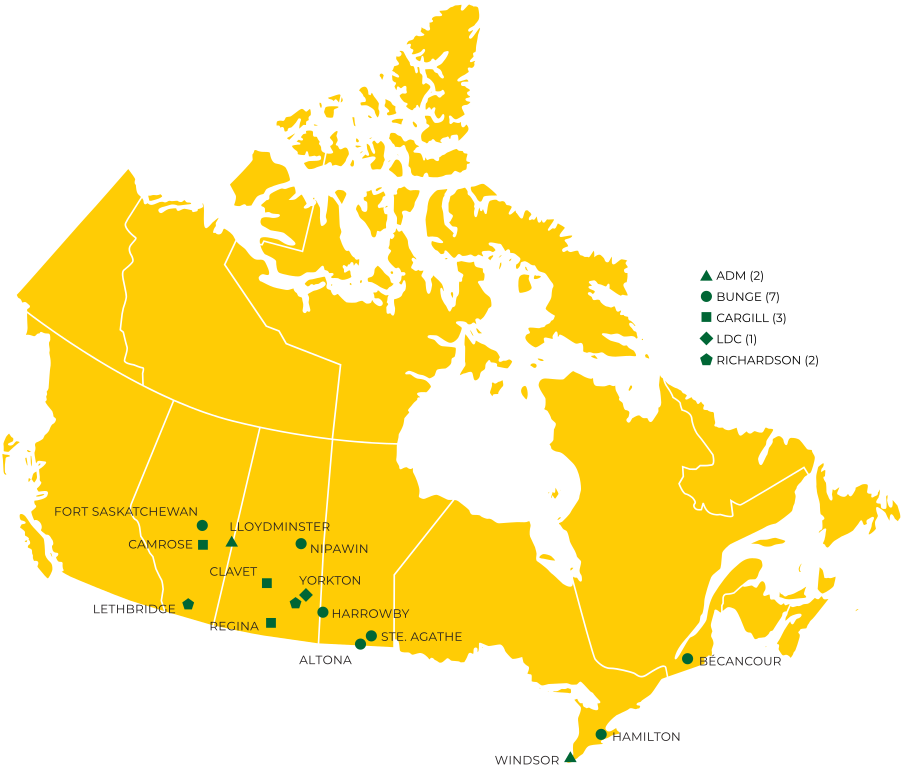
There are 14 oilseed crushing facilities in Canada. The plants in Western Canada process canola seeds and the plants in eastern Canada process canola and soybeans. The plant locations are shown in the following figure.
Periodically COPA surveys its members to track energy use at the facilities. Three of the 14 facilities process both canola and soybeans and these facilities have not been included in this analysis.
Three of the 14 facilities process both canola and soybeans and these facilities have not been included in this analysis.
The energy consumption can vary with the canola seed properties which can vary year to year with the growing conditions. To accommodate the annual variations the results from 2021 to 203 are averaged in this report. The results of the survey are shown in the following tables
| wdt_ID | Source | Total | Per tonne of seed processed |
|---|---|---|---|
| 2 | Natural Gas, GJ (HHV) | 8,669,203 | 0.99 |
| 3 | Electricity, kWh | 379,241,928 | 43.35 |
The energy data can also be presented in the format required for the GREET model, where the units are BTU (LHV) and pounds. The information is shown in the following table.
| wdt_ID | Source | Per Pound of Oil Unallocated |
|---|---|---|
| 2 | Natural Gas, BTU (LHV) | 914 |
| 3 | Electricity, BTU | 160 |
| 4 | Total Energy, BTU | 1,073 |
Canola Oilseed Processors Association (COPA) is a federally incorporated non-profit industry association that works in partnership with the Canola Council of Canada (CCC) to represent the interests of oilseed processors in Canada.
The purposes of the corporation are:
There are 14 oilseed crushing facilities in Canada. The plants in Western Canada process canola seeds and the plants in eastern Canada process canola and soybeans. The plant locations are shown in the following figure.
Figure 1-1 Oilseed Crushing Facilities in Canada
Periodically COPA surveys its members to track energy use at the facilities.
Three of the 14 facilities process both canola and soybeans and these facilities have not been included in this analysis.
The energy consumption can vary with the canola seed properties which can vary year to year with the growing conditions. To accommodate the annual variations the results from 2021 to 203 are averaged in this report.
The process for turning canola seed into oil and meal is similar to how other oilseeds are processed. Seed is preconditioned and pressed to separate the oil from the solids. Further refining and processing create finished canola products, ready for the market or further processing. The process is shown in the following figure.
FIGURE 2-1 Oilseed Crushing Process
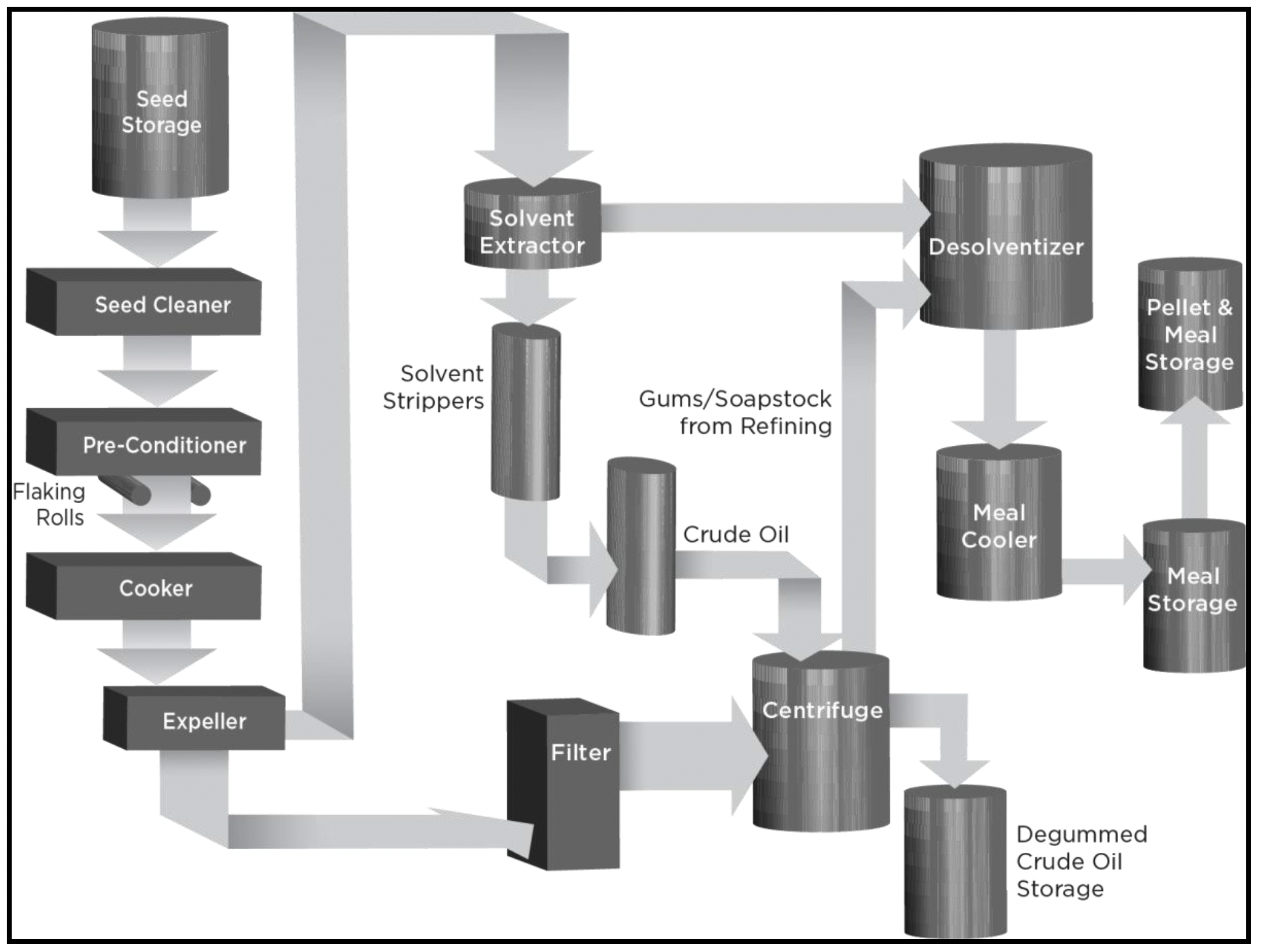
The steps in the process are briefly described below.
Cleaning
First canola seed is thoroughly cleaned to remove “dockage” – weed seeds, stems, pods and other materials that may be picked up as canola is harvested.
Heating and flaking
Canola is heated and flaked before extraction so more oil can be released. The temperature is slightly raised in grain dryers to prevent shattering. The seed is then passed through rollers to gently rupture the cell walls and flake the seed to just the right thickness.
Seed cooking
Next the flakes go through a series of heating drums or stack-type cookers. This ruptures more cells and optimizes the viscosity of the oil and moisture of the flakes for the processes ahead. Cooking also prevents the breakdown of products that could affect quality.
Pressing
The cooked flakes then go through a series of screw presses or expellers for a mild pressing. This process removes most of the oil and compresses the rest of seed into cake.
Solvent extraction
To remove the remaining oil, the presscake is put into an extractor and saturated with an approved food-grade solvent called hexane. The solvent percolates through the cake and separates nearly all of the remaining oil. The hexane is then removed from the oil and solids, reused and recycled.
Further oil refining and processing
Crude canola oil is further refined to improve colour, flavour and shelf life. Water and organic acids may be used to remove lipids, gums, free fatty acids and fine meal particles. Color pig-ments are removed by passing oil through a filter containing natural clay (a process sometimes called “bleaching,” although no bleach is used). The final step is to remove any unpleasant odours or compounds with steam distillation.
At this point, canola oil is ready to be packaged and sold as cooking oil, or further processed into a wide range of consumer and commercial products.
Meal processing
After the oil has been removed, the remaining solids are processed into canola meal, a protein source used in animal feed. The meal is placed on heated plates and injected with live steam – a process called toasting – to remove the remaining solvent. After it has been cooled, dried and granulated, the meal may be pelleted or sent directly to storage.
The eleven ‘canola only’ crush facilities produced crude canola oil, refined canola oil, and canola meal. The ratio of crude canola oil to refined canola oil varies between facilities and the facilities do not all have the capacity to separate the energy consumed between crude and refined canola oil. The energy consumption data presented in the next section does not differentiate between the two grades of canola oil. Over time the percentage of the canola oil that is refined has been increasing.
The average data for the 2021 to 2023 period is shown in the following table.
| wdt_ID | Parameter | Value |
|---|---|---|
| 2 | Canola Seed processed, tonnes as received | 8,749,820 |
| 3 | Crude canola oil produced, tonnes | 3,672,297 |
| 4 | Refined canola oil produced, tonnes | 2,532,006 |
| 5 | Canola Meal produced, tonnes as produced | 5,067,343 |
The industry standard moisture content is 8.5% for the seed. The actual moisture content is usually between 7.5 and 8.0%.
The industry standard moisture for the meal is 12%.
The oil recovered on a dry weight basis is shown in the following table.
| wdt_ID | Parameter | Value |
|---|---|---|
| 2 | Dry weight processed, tonnes | 8,006,085 |
| 3 | Oil recovered, tonnes | 3,672,297 |
| 4 | Recovery rate, % | 45.9 |
The energy required for the crushing process includes thermal energy and electrical energy.
Both are discussed below.
The 11 facilities all utilize natural gas for their thermal energy requirements. A few facilities have co-generation equipment so some or all of the electricity consumed in the process is supplied internally.
Only the electricity purchased from the local utility is included in the data provided. The electricity consumed that is provided by cogeneration is accounted for in the natural has purchases.
The energy Data is presented in the following table.
| wdt_ID | Source | Total | Per tonne of seed processed |
|---|---|---|---|
| 2 | Natural Gas, GJ (HHV) | 8,669,203 | 0.99 |
| 3 | Electricity, kWh | 379,241,928 | 43.35 |
The energy data can also be presented in the format required for the GREET model, where the units are BTU (LHV) and pounds. The information is shown in the following table.
| wdt_ID | Source | Per Pound of Oil Unallocated |
|---|---|---|
| 2 | Natural Gas, BTU (LHV) | 914 |
| 3 | Electricity, BTU | 160 |
| 4 | Total Energy, BTU | 1,073 |
The actual energy consumption is 86% of the value in GREET 2024.